Find what costs the sale, before it costs the customer.
Send simulated shoppers from discovery to checkout and see where product information, trust, delivery, mobile usability or unexpected friction changes the buying decision.
Delivery cost appears only after the customer starts checkout
Shoppers interpreted “ready to order” as a complete price, then lost confidence when an additional delivery charge appeared after entering details.
Show the delivery threshold and likely charge beside the purchase decision, before checkout begins.
A sale can be lost long before the payment form fails.
PersonaQA follows the shopper’s reasoning across the full journey. What they search for, compare, trust, question and ultimately decide.
Product discovery
Can shoppers find the right category, filter meaningfully and recover from a poor result?
Product understanding
Do imagery, variants, dimensions, compatibility and stock answer the buying questions?
Trust and reassurance
Are reviews, returns, guarantees and proof available where uncertainty occurs?
Price and delivery
Can customers predict the complete cost, timing and conditions before committing?
Mobile purchase friction
Do overlays, sticky elements, forms or missing controls make the journey harder?
Checkout confidence
Does every step explain what is required, what happens next and how to correct mistakes?
See why the customer’s decision changed.
Your commerce stack measures outcomes at scale. PersonaQA adds the missing customer interpretation behind the journey.
Where shoppers leave
Funnels, baskets and transactions show which pages and steps lose revenue.
Where shoppers struggle
Recordings expose visible behaviour such as repeated clicks, scrolling and backtracking.
Why they may not buy
Simulated shoppers reveal the missing information, ambiguity or reassurance behind the decision.
Shop. Diagnose. Improve. Protect.
Run representative buying missions, prioritise evidence-backed barriers and keep important revenue journeys under watch.
Choose the shopper
Define intent, product need, confidence, budget, device and purchase goal.
Run the journey
The shopper navigates the real storefront from landing page to decision.
Prioritise friction
Combine repeated observations into clear, commercially relevant actions.
Monitor change
Rerun critical journeys after campaigns, merchandising changes and deployments.
Challenge one journey from several buying perspectives.
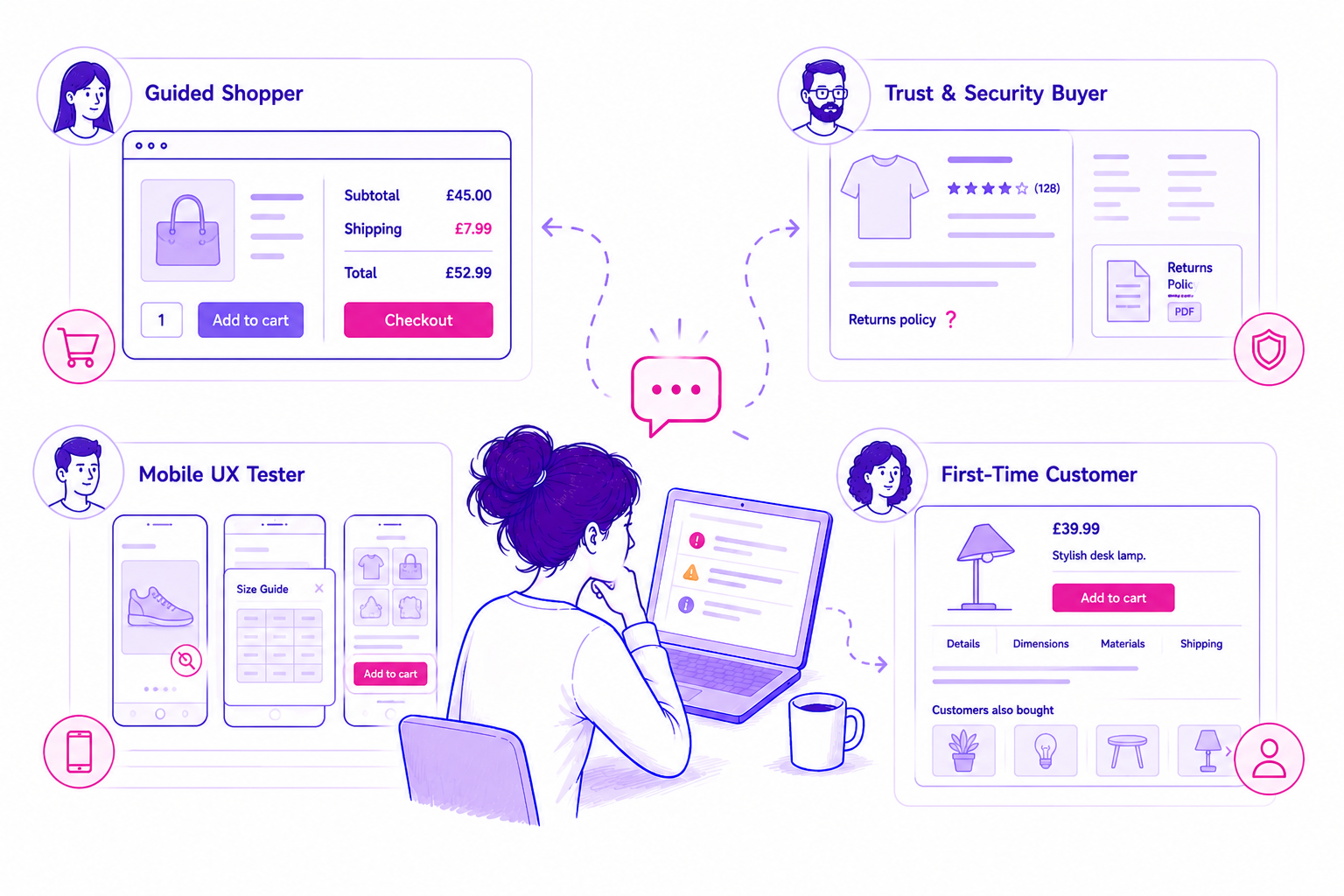
A cautious first-time buyer, a comparison shopper and a mobile returning customer do not need the same evidence or behave in the same way.
“Can I trust this store?”
Tests product clarity, credibility, delivery expectations and reassurance.
“Why should I choose this?”
Tests differentiation, value, evidence and the ease of comparing options.
“Can I finish this quickly?”
Tests navigation, overlays, variants, forms and payment on a constrained screen.
See the friction in the context of the purchase journey.
PersonaQA shows what each shopper encountered, how confidence changed and why the journey continued or stopped. Payment is never completed; the experience is assessed up to the point of purchase.
Existing PersonaQA ecommerce report view
Protect high-value journeys through every storefront change.
Run defined shopping missions weekly or after deployment. PersonaQA compares the journey evidence and confirms whether the customer outcome has genuinely worsened.
Choose the pressure test your storefront needs.
Each Snapshot brings several specialist perspectives into one prioritised, shareable assessment.
Customer Behaviour
Understand what changes purchase confidence and why simulated shoppers hesitate.
- Product and pricing clarity
- Trust and decision friction
- Prioritised conversion actions
Search & AI Credibility
Check whether search and AI systems can understand products, policies and proof.
- Search intent fulfilment
- Product and entity clarity
- Machine-readable credibility
UX & Accessibility
Find usability and accessibility barriers from navigation through checkout.
- Mobile and form friction
- Keyboard and screen-reader risks
- Evidence mapped to standards
Let simulated shoppers find the friction first.
Run a Customer Behaviour Snapshot on your storefront and see what customers understand, question and decide.